
How to Choose the Best Fiber Laser Diode for Your Needs?
Choosing the right Fiber Laser Diode begins with the application, not the product label. A component suited to metal cutting may perform poorly in sensing, communications, or medical instrumentation. Wavelength, output power, beam quality, modulation speed, and thermal stability all shape the final result. The choice becomes practical when these specifications match real operating conditions.
Valentin Gapontsev, founder of IPG Photonics and a major fiber-laser pioneer, said, “Fiber lasers are the future of lasers.” His view reflects the technology’s strong efficiency, compact structure, and dependable beam delivery. Yet a promising datasheet is not enough. A diode can show excellent power in a laboratory and still disappoint inside a dusty factory enclosure. Check the operating temperature, coupling method, connector design, cooling requirements, and expected service life. Small details matter.
Start with the working wavelength. Confirm that it matches the gain medium, coatings, detectors, and optical components. Then examine slope efficiency and power stability under continuous operation. A low-cost diode may appear attractive initially. Replacement downtime can make it expensive later. Ask suppliers for test data, burn-in procedures, warranty terms, and traceable quality records. Independent measurements are even better.
There is no universal best choice. That is the uncomfortable part. Engineers sometimes prioritize peak power and overlook long-term reliability. Others select excessive specifications that add cost without improving performance. A careful comparison should include the complete system, not merely the diode itself. With clear requirements and realistic testing, buyers can choose a Fiber Laser Diode that performs reliably beyond the brochure.
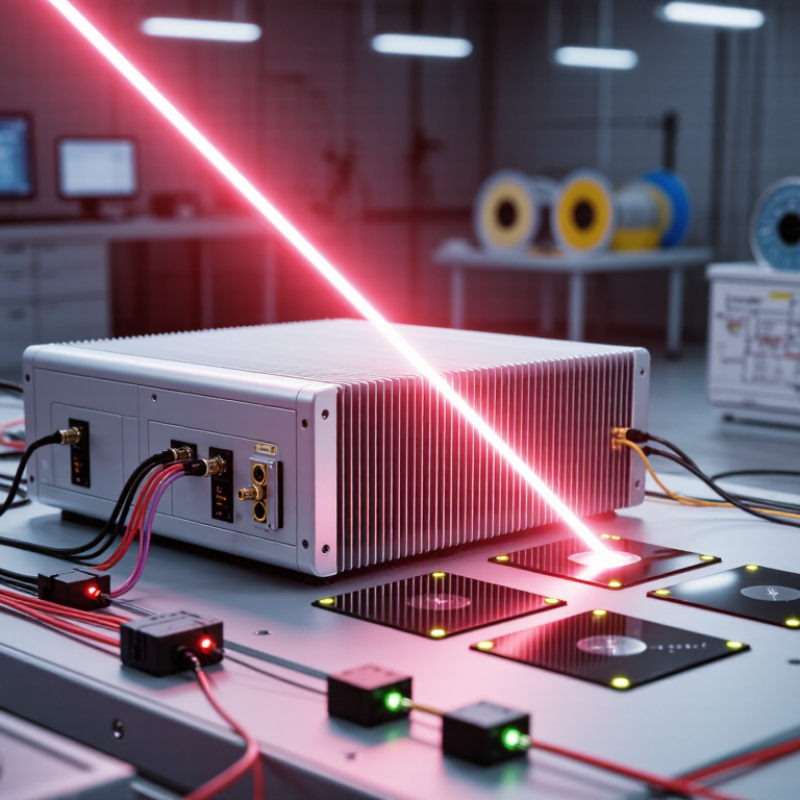
What Is a Fiber Laser Diode and How Does It Work?
A fiber laser diode is a semiconductor pump source, not the complete fiber laser. Inside its p-n junction, electrical current produces photons. The diode usually emits near 915 or 976 nanometers. Lenses then guide this light into an optical fiber. That fiber contains a rare-earth-doped core, often using ytterbium. Pump light excites the dopant ions. Stimulated emission follows. Mirrors or fiber Bragg gratings reinforce one wavelength, creating a focused laser beam.
The process is small but unforgiving. Poor alignment wastes pump power and increases heat. A practical inspection should check coupling efficiency, optical output, wavelength stability, and thermal resistance. Cooling matters. Even a few degrees can shift performance. MarketsandMarkets’ Fiber Laser Market report, published in 2024, estimates growth from about USD 7.3 billion in 2024 to USD 13.5 billion by 2029. That 13.1% projected annual growth reflects rising demand for efficient industrial sources, but market growth does not guarantee every diode will suit your system.
Selection should match the gain fiber, drive current, cooling method, and required duty cycle. A higher-power diode may appear attractive. It can also create unnecessary thermal stress. Datasheets often show ideal laboratory values, not dusty factory conditions. This is where judgment becomes imperfect. Test the diode under your real temperature, vibration, and operating schedule before committing to volume use. Reliability data, lifetime testing, and clear measurement methods deserve more attention than headline wattage.
How to Choose the Best Fiber Laser Diode for Your Needs? - What Is a Fiber Laser Diode and How Does It Work?
| Selection Dimension | Typical Options or Range | What It Means | Recommended Use | Key Selection Advice |
|---|---|---|---|---|
| Operating Principle | Semiconductor laser diode coupled into an optical fiber | Electrical energy is converted into laser light, which is confined and guided through the fiber core. | Fiber-coupled pumping, material processing, medical equipment, sensing, and communications. | Confirm whether the product is intended as a pump source, a direct-diode source, or a signal source. |
| Pump Wavelength | Approximately 793–805 nm Approximately 915–976 nm | The wavelength determines how efficiently the diode can pump the active gain medium and affects thermal management. | Around 793–805 nm: selected for specific absorption characteristics in some rare-earth-doped fibers. Around 915–976 nm: widely used for ytterbium-doped fiber pumping. | Match the diode wavelength to the absorption band of the active fiber. A wavelength mismatch can reduce efficiency. |
| Output Power | Less than 1 W to several watts: compact systems Tens of watts: industrial modules Hundreds of watts: high-power pump assemblies | Output power affects achievable laser power, processing speed, and the required cooling capacity. | Low power for sensing and compact instruments; higher power for cutting, welding, cladding, and pumping fiber amplifiers. | Choose enough power for the application while avoiding unnecessary thermal load and electrical consumption. |
| Electrical-to-Optical Efficiency | Commonly about 30%–60%, depending on wavelength, drive current, temperature, and package design | Efficiency indicates how much electrical input is converted into useful optical output. | Important for battery-powered, air-cooled, and high-duty-cycle systems. | Compare efficiency at the actual operating current and temperature rather than relying only on a maximum rating. |
| Fiber Core Diameter | Typically about 50–600 µm for high-power pump delivery; smaller cores are used for lower-power applications | The core diameter influences power-handling capability, coupling tolerance, and beam quality. | Larger cores for high-power pumping; smaller cores where compactness or better spatial control is more important. | Ensure compatibility with the receiving fiber and verify the allowed power density at the fiber input. |
| Numerical Aperture | Common high-power fiber-coupled values are approximately 0.12–0.22 | Numerical aperture describes the range of angles that the fiber can accept or emit. | Determines coupling efficiency and compatibility with pump combiners, gain fibers, and optical assemblies. | The diode fiber NA should be compatible with the downstream optical system to minimize coupling losses. |
| Fiber Type | Multimode fiber Polarization-maintaining fiber Single-mode fiber | Fiber type affects beam quality, polarization stability, coupling requirements, and system complexity. | Multimode: high-power pumping and robust industrial systems. Polarization-maintaining: polarization-sensitive applications. Single-mode: applications requiring high beam quality. | Select the fiber type based on beam-quality requirements, not only on output power. |
| Spectral Bandwidth | Typically narrow enough for pumping, but exact bandwidth varies with diode structure and operating conditions | Bandwidth affects absorption efficiency, wavelength stability, and sensitivity to temperature. | Narrower spectra are useful when the gain medium has a narrow absorption feature or when wavelength control is critical. | Check center wavelength, spectral width, and wavelength shift over the full operating temperature range. |
| Cooling Method | Natural convection, forced air, conduction cooling, or liquid cooling | Cooling removes heat generated by electrical inefficiency and helps maintain stable output. | Air cooling for compact or moderate-power equipment; liquid cooling for high-power and continuous-duty systems. | Size the cooling system for worst-case ambient temperature and continuous operation, not typical laboratory conditions. |
| Operating Temperature | Often approximately 0–45 °C for controlled equipment; exact limits depend on the module | Temperature changes can affect wavelength, output power, lifetime, and coupling stability. | Industrial, outdoor, and mobile systems require broader environmental tolerance. | Verify both the diode operating range and the storage range, and include temperature-control requirements in the design. |
| Drive Current and Control | Constant-current operation with soft start, current limiting, and monitoring | Laser diodes are sensitive to current spikes and electrical transients. | All applications, especially systems requiring long operating life and repeatable optical output. | Use a properly matched driver with protection against overcurrent, reverse voltage, and uncontrolled startup. |
| Beam Quality | Single-mode or multimode; often specified using M², brightness, or étendue | Beam quality determines how efficiently the light can be focused, combined, or launched into another fiber. | High-brightness processing, precision marking, pumping, and beam-combining systems. | Do not select solely by power. Confirm M², near-field pattern, far-field divergence, and stability when relevant. |
| Modulation Capability | Continuous-wave, pulsed, or analog/digital modulation, depending on the driver and diode design | Modulation determines how quickly and accurately optical output can be controlled. | Continuous-wave for steady pumping; modulation for sensing, communications, marking, and process control. | Check modulation bandwidth, rise time, pulse limits, and the effect of modulation on thermal load. |
| Reliability and Lifetime | Often specified using expected operating hours under defined temperature and drive conditions | Lifetime depends strongly on junction temperature, drive current, contamination, vibration, and optical feedback. | Long-duty industrial equipment, medical devices, research instruments, and remote systems. | Operate below maximum ratings, maintain clean optical interfaces, and provide adequate heat removal. |
| Optical Safety | Laser safety classification depends on accessible output power and wavelength | Fiber-coupled light can remain hazardous even when the emitting spot is small or not visible. | Every system using a fiber laser diode. | Use suitable enclosures, interlocks, beam stops, warning labels, and wavelength-appropriate protective eyewear. |
| Best Overall Choice | A diode whose wavelength, power, fiber geometry, cooling, and control method match the complete system | The highest-rated diode is not always the most suitable or economical option. | Application-specific selection across industrial, scientific, medical, and communications systems. | Prioritize compatibility, thermal margin, required beam quality, reliability, and total operating cost. |