
China has become an important sourcing base for low-voltage air circuit breakers, including compact and drawout designs. A reliable ACB Breaker supplier should offer more than attractive pricing. It should demonstrate stable production, documented testing, and responsive engineering support.
Dr. John Cadick, an electrical safety specialist and author of the Electrical Safety Handbook, stated, “Safety depends on disciplined design, installation, and maintenance.” This principle remains highly relevant when evaluating Chinese ACB manufacturers. Buyers should examine short-circuit ratings, rated current, insulation voltage, trip-unit accuracy, and mechanical endurance. They should also request type-test reports based on IEC 60947-2 requirements.
Look closely at the factory details. Are copper terminals protected from contamination? Are contact assemblies inspected after machining? Can the supplier provide serial-number traceability for each ACB Breaker? These small points often reveal operational maturity.
Several Chinese manufacturers serve export markets with products ranging from 400A to 6,300A. Some provide fixed, drawout, and intelligent electronic trip versions. Others support Modbus communication, remote operation, and selective coordination studies. Yet product catalogs can appear more impressive than actual field performance. That is worth remembering.
A dependable supplier should support sample testing, panel integration, spare-part planning, and after-sales troubleshooting. Certifications matter, but certificates alone do not prove consistent quality. Factory audits, reference projects, and witnessed testing provide stronger evidence. The best choice may not be the cheapest quotation. It is the manufacturer that combines engineering depth, transparent documentation, and dependable delivery. Mistakes still happen. Careful verification reduces their cost.
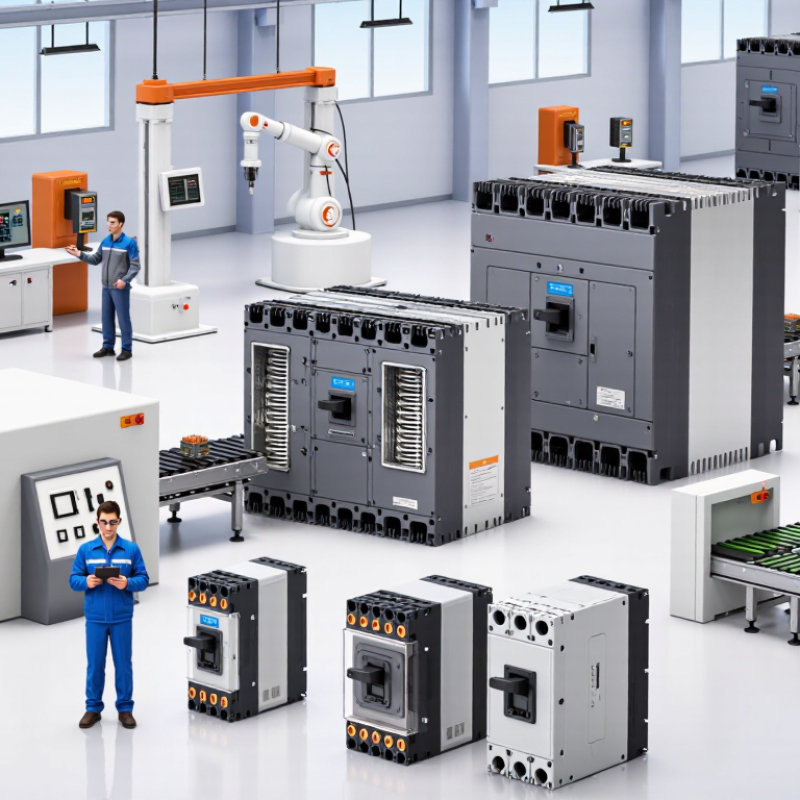
An air circuit breaker, or ACB, is a low-voltage switching device using air to extinguish electrical arcs. It protects circuits from overloads, short circuits, and prolonged abnormal current. Unlike compact breakers, ACBs often support higher current ratings and adjustable protection settings. They also allow remote operation, status monitoring, and selective coordination.
The IEC 60947-2 standard defines key requirements for low-voltage circuit breakers, including testing, insulation, and interruption performance. According to the International Energy Agency’s Electricity 2024 report, global electricity demand is expected to grow by about 4% annually through 2025. This growth increases pressure on distribution systems, especially in factories, data centers, hospitals, and large commercial buildings. ACBs commonly protect main incoming feeders, busbars, generators, and high-capacity motors. They are visible inside switchgear, with copper busbars carrying heavy current nearby.
A 2024 industry market report estimates the global circuit breaker market at more than USD 8 billion. The number is useful, but market definitions vary. That weakness matters. Engineers should not select an ACB from market size alone. They should verify rated current, breaking capacity, short-time withstand current, installation altitude, and maintenance access. In practice, a poorly coordinated trip setting can interrupt healthy equipment or delay fault clearance. Testing records and supplier documentation remain essential.
China’s ACB manufacturing industry has developed around strict low-voltage equipment requirements and practical export experience. Air circuit breakers are commonly evaluated against IEC 60947-2 and its applicable Chinese standards, including GB/T 14048.2. These references cover rated voltage, breaking capacity, insulation performance, temperature rise, and mechanical endurance.
A reliable manufacturer should connect design records with production evidence. Engineers typically inspect copper conductors, contact pressure, arc chutes, trip units, and terminal torque. Routine tests may include insulation checks, operational testing, and protection-function verification. Type tests require deeper evaluation, such as short-circuit interruption and temperature-rise performance. Accredited laboratories and traceable test reports make supplier comparisons more meaningful.
Factory audits reveal details that brochures often miss. Look for calibrated instruments, controlled assembly areas, serial-number tracking, and clear corrective-action records. ACB quality can change when tolerances are handled poorly. Small contact alignment errors may cause heating after repeated operation. No checklist is perfect. Field conditions, installation practices, and maintenance intervals still influence performance. Suppliers should explain their assumptions, not hide them behind certificates. Procurement teams can request sample reports, wiring diagrams, inspection plans, and documented tests for each configuration. Some specifications remain unclear until engineers review the actual panel environment. That is where careful communication matters.
Common rated-current classes for low-voltage air circuit breakers used in industrial and commercial power-distribution systems. The chart reflects typical market-standard ratings and does not represent sales data from any individual company or brand.
In China, ACB products are generally designed and tested within the low-voltage circuit-breaker framework of GB/T 14048.2, which is aligned with the international IEC 60947-2 series. Common ACB rated-current classes range from 630 A to 6300 A, while the final selection depends on rated voltage, short-circuit breaking capacity, protection functions, installation conditions, and coordination requirements.
Leading China ACB breaker manufacturers and suppliers serve factories, data centers, commercial buildings, and power distribution projects worldwide. Experienced suppliers usually provide air circuit breakers from 630A to 6300A, with adjustable protection settings and electronic trip units. Their engineering teams should explain rated current, short-circuit capacity, pole configuration, and installation conditions clearly. Reliable manufacturers also maintain production records, routine test procedures, and traceable quality inspections. Ask for test reports aligned with IEC 60947-2 and confirm whether the documents match the actual model.
Tips: Check the frame size, rated service voltage, breaking capacity, and communication options before ordering. Request wiring diagrams and installation dimensions early. A small mismatch can delay panel assembly. Not every low-price quotation is a problem, but it deserves closer checking. Compare copper connections, contact materials, trip-unit accuracy, and after-sales response. Factory audits, sample testing, and video inspections can reveal details that catalog pages miss.
Many Chinese suppliers support OEM requirements, customized labels, and export packaging. However, customization may affect lead time, spare parts, and future maintenance. Discuss operating temperature, altitude, humidity, and indoor or outdoor use with a technical representative. One practical lesson is easy to overlook: a breaker can pass factory tests yet perform poorly when the surrounding cabinet is badly designed. Select suppliers that offer commissioning guidance, fault-analysis support, and clear warranty terms. Keep records of settings and test results for future service work.
China Top ACB Breaker Manufacturers and Suppliers
China’s ACB suppliers should be compared by verified performance, not catalog price alone. The IEA’s Electricity 2024 report forecasts global electricity demand to grow by about 4% in 2024, 2025, and 2026. This growth increases pressure on low-voltage distribution equipment and technical support.
Ask for original type-test reports, not only scanned certificates. Check rated current, service breaking capacity, ultimate breaking capacity, short-time withstand current, and mechanical endurance. IEC 60947-2 compliance is essential, but test conditions must match your project. Review temperature-rise data at the actual operating current. Missing evidence is a warning. Factory audits should examine busbar joints, contact assembly, insulation control, and final inspection records. Calibration records matter too.
Compare total cost over the expected service life. The IEA’s World Energy Investment 2024 report estimates global energy investment will reach about 3 trillion US dollars, with clean-energy investment near 2 trillion. More infrastructure spending may increase demand for dependable switchgear. Still, the cheapest quotation can hide weaker accessories, longer maintenance time, or limited spare-parts access. Request a sample inspection, delivery history, warranty response times, and remote troubleshooting procedures. A practical weakness remains: buyers often compare price before verifying protection settings and replacement lead times. That order deserves reconsideration.
| Comparison Dimension | Common Range or Requirement | What to Check with a Chinese Supplier | Relevant Standard or Test | Evaluation Priority |
|---|---|---|---|---|
| Rated Current (In) | Typically 630 A to 6,300 A for low-voltage air circuit breakers. | Confirm the continuous-current rating, frame size, derating data, and compatibility with the busbar system. | IEC 60947-2; rated current and temperature-rise verification. | High |
| Rated Operational Voltage (Ue) | Common low-voltage ratings include 380 V, 400 V, 415 V, 440 V, 500 V, 690 V, and up to 1,000 V AC depending on the design. | Verify the exact voltage rating at 50 Hz or 60 Hz and confirm whether the breaker is suitable for the target network. | IEC 60947-2; manufacturer technical data sheet. | High |
| Ultimate Short-Circuit Breaking Capacity (Icu) | Common product ratings range from approximately 42 kA to 120 kA, depending on voltage, frame size, and product series. | Compare Icu at the actual operating voltage rather than comparing the maximum value listed for another voltage. | IEC 60947-2 short-circuit test requirements. | Critical |
| Service Short-Circuit Breaking Capacity (Ics) | Often specified as a percentage of Icu, such as 50%, 75%, or 100%, depending on the breaker series. | Request the Ics value at the required voltage and confirm whether the breaker can be returned to service after the test sequence. | IEC 60947-2; Ics test sequence. | Critical |
| Number of Poles | Three-pole and four-pole configurations are common in low-voltage distribution systems. | Check neutral-pole switching, neutral-pole protection, phase spacing, and installation orientation. | IEC 60947-2; system design requirements. | High |
| Installation Type | Fixed and draw-out versions are widely available. | Compare cradle dimensions, connected/test/disconnected positions, shutters, mechanical interlocks, and racking mechanisms. | IEC 60947-2; product construction and safety tests. | High |
| Electronic Trip Unit | Common protection functions include long-time, short-time, instantaneous, and ground-fault protection. | Confirm adjustable pickup ranges, time delays, true RMS measurement, communication options, event records, and trip indication. | IEC 60947-2; protection coordination study. | Critical |
| Electrical Accessories | Typical options include shunt trip, undervoltage release, closing coil, motor operator, auxiliary contacts, and alarm contacts. | Verify coil voltage options, control-circuit ratings, wiring terminals, accessory compatibility, and spare-part availability. | IEC 60947-2; control and auxiliary-circuit specifications. | High |
| Mechanical and Electrical Life | The number of operating cycles varies by frame size, utilization category, operating mechanism, and accessory configuration. | Request the rated mechanical and electrical endurance separately, including the operating conditions used for testing. | IEC 60947-2 endurance tests. | Medium |
| Insulation and Impulse withstand | Low-voltage ACB designs commonly specify an insulation voltage up to 1,000 V and an impulse withstand level commonly up to 12 kV, depending on the series. | Check the exact Ui and Uimp values, clearances, creepage distances, and altitude limitations. | IEC 60947-2 dielectric and impulse tests. | High |
| Environmental Conditions | Operating temperature, humidity, altitude, pollution level, and enclosure conditions can affect the declared performance. | Ask for temperature derating, altitude correction, storage limits, humidity limits, corrosion protection, and enclosure compatibility. | IEC 60947-1 and IEC 60947-2 environmental requirements. | High |
| Factory Quality Control | Routine verification should be performed on each completed breaker before shipment. | Request routine-test records, calibration certificates, inspection plans, traceability procedures, and sample type-test reports. | IEC 60947-2 routine verification and quality-management procedures. | Critical |
| Certification and Market Access | Required documentation depends on the destination market, project specification, and applicable conformity rules. | Verify valid test reports, declarations of conformity, certification scope, report model numbers, and document authenticity. | IEC 60947 series; applicable regional conformity requirements. | Critical |
| Customization Capability | Customization may cover trip settings, control voltage, terminals, communication protocols, labels, and mechanical interfaces. | Confirm minimum order quantity, engineering-change control, drawing approval process, sample policy, and tooling responsibility. | Approved technical specification and contract documentation. | Medium |
| Lead Time and Spare Parts | Lead time depends on product configuration, production capacity, testing requirements, and accessory availability. | Compare confirmed production schedules, spare-parts stock, warranty terms, technical support, and after-sales response procedures. | Purchase contract, warranty terms, and service-level agreement. | High |
| Total Cost of Ownership | The purchase price is only one cost element; installation, testing, energy losses, maintenance, replacement parts, and downtime also affect lifecycle cost. | Compare the complete bill of materials, logistics, commissioning, maintenance intervals, warranty coverage, and expected service life. | Project cost model and approved technical specification. | High |
Note: Product ratings and available configurations vary by supplier and model. Final selection should be based on the supplier's current technical documentation, verified test reports, and the electrical requirements of the intended installation.
China’s ACB suppliers serve power distribution projects across many regions. The IEA Electricity 2024 report expects global electricity demand to grow by about 3.4% annually from 2024 to 2026. This supports continued demand for reliable low-voltage protection equipment. However, export capability involves more than a competitive quotation. Buyers should check product documentation, response time, packaging standards, and after-sales support before placing an order.
Quality control should follow IEC 60947-2 requirements for low-voltage circuit breakers. Ask for routine test records, temperature-rise results, short-circuit test evidence, and calibration certificates. The ISO Survey 2022 reported more than 1.2 million ISO 9001 certificates worldwide. Yet certification alone proves little. A certificate is not proof of perfect production. Factory audits should examine incoming copper, contact materials, insulation parts, assembly records, and final inspection procedures. Small gaps matter.
Export services also deserve close attention. Suppliers should provide accurate HS classification support, bilingual manuals, wooden-case protection, and clear shipping documents. The World Bank’s Logistics Performance Index 2023 shows that customs efficiency and shipment reliability remain important differences between exporting markets. Buyers should confirm voltage, rated current, breaking capacity, control voltage, installation method, and spare-parts availability. Request samples when possible. Real testing may reveal inconvenient details, including unclear labels or slow trip mechanisms. No supplier is flawless. Careful verification remains the safer purchase decision.
Join our mailing list to receive the latest news and updates from our team.