Why Choose Sport Smart Glasses for Global Sourcing?
Why Choose Sport Smart Glasses for Global Sourcing?
Sport Smart Glasses are moving from experimental accessories toward practical connected equipment. IDC reported that worldwide wearable device shipments reached approximately 537.6 million units in 2024. Smart glasses remain a smaller category, but Counterpoint Research has documented strong growth in AI-enabled and camera-equipped glasses. These figures suggest rising consumer interest, although market reports often group different products together. That limitation deserves attention.
For global buyers, sourcing Sport Smart Glasses can combine fitness functionality, hands-free information, and brand differentiation. A runner may check navigation through a compact display, while a cyclist records a route without reaching for a phone. Suppliers should provide clear specifications for battery capacity, charging cycles, Bluetooth stability, lens protection, microphone quality, and sweat resistance. Small details matter. A loose hinge or weak nose pad can damage user confidence quickly.
Professional sourcing also requires evidence beyond attractive samples. TÜV Rheinland, SGS, and Intertek testing can support verification of product safety and material claims. Depending on the destination market, buyers may need documentation related to radio equipment, battery transport, electromagnetic compatibility, RoHS, or product labeling. Requirements differ by country and product configuration. Do not rely on a generic compliance certificate.
Deloitte’s Digital Consumer Trends research shows continued consumer interest in connected devices, but adoption depends on comfort, usefulness, and trust. Therefore, suppliers should offer pilot orders, firmware update policies, repair support, and transparent warranty terms. The opportunity is real. The risks are real too. A lower unit price may hide poor optical performance, unstable software, or inconsistent quality between batches.
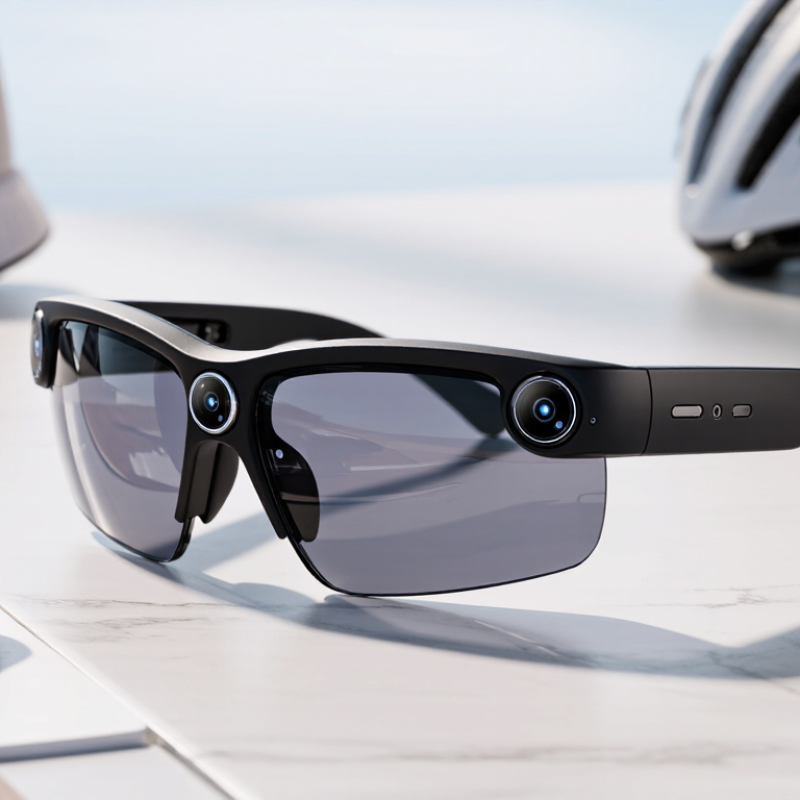
Definition: Sport Smart Glasses Combine Sensors, Displays, Cameras, and Connectivity
Sport smart glasses combine sensors, displays, cameras, and connectivity in a wearable frame. Sensors can track motion, orientation, temperature, or heart activity. A compact display may show pace, route cues, or training alerts near the user’s view. Cameras can record movement or support visual analysis, while wireless connectivity transfers data to another device. The definition sounds neat, but real products are more complicated.
For global sourcing, buyers should examine how these parts work together, not just compare feature lists. During sample evaluation, check display brightness under sunlight, sensor accuracy during running, camera stability, and connection performance in crowded environments. Battery life also matters. A powerful processor may shorten a full training session. Comfort is easy to underestimate; a heavy frame can become painful after an hour.
Reliable suppliers should provide clear specifications, test records, firmware information, and repeatable quality controls. Ask how each batch is inspected. Ask again when answers seem vague. Data handling also deserves careful review, especially when cameras and connected applications are involved. Regional requirements may differ, so technical documents and user instructions should be prepared for the target market. No sample proves everything. Field testing remains necessary, because sweat, rain, sunlight, and imperfect movement can expose weaknesses that laboratory checks miss.
Market Signal: IDC Reports 500M+ Wearable Devices Shipped Globally
Why Choose Sport Smart Glasses for Global Sourcing?
IDC reports more than 500 million wearable devices shipped globally, making wearables a serious sourcing signal. That scale shows broad consumer familiarity, but it does not guarantee every smart-glasses feature will sell. Sport smart glasses add practical value through hands-free coaching, route guidance, call access, and activity recording. On a cycle path, a small lens display can reduce the need to check a phone. That moment matters.
For global buyers, product selection should begin with evidence, not attractive renders. Request optical test data, battery-cycle results, impact resistance records, and clear software update policies. Check how the frame performs after sweat, dust, bright sunlight, and repeated adjustment. A reliable supplier should explain factory controls, component traceability, quality sampling, and after-sales handling. Ask for samples from different production batches. One sample can mislead.
The 500M-plus shipment figure also supports a wider component ecosystem and more experienced manufacturing capacity. That can improve lead times and customization options for international sourcing projects. Still, buyers should examine comfort, lens clarity, charging design, data protection, and regional user habits. A lightweight frame may feel ideal indoors but slide during a humid outdoor workout. I would also test voice control in wind, where polished demonstrations often hide weaknesses. The market is promising, yet disciplined validation remains necessary.
Why Choose Sport Smart Glasses for Global Sourcing?
Market signal: Global wearable device shipments reached more than 500 million units in 2023, indicating strong demand for hands-free, connected products such as sport smart glasses.
Global wearable device shipments, 2019–2023. Figures are reported in millions of units. Source: IDC Worldwide Quarterly Wearable Device Tracker.
Performance Criteria: IEC 60529 IP67 Means 1 m Water Protection for 30 Minutes
Why Choose Sport Smart Glasses for Global Sourcing?
Sport smart glasses require more than optical clarity and battery performance. Their enclosure must withstand sweat, rain, splashes, and accidental drops during active use. IEC 60529 defines IP67 as dust-tight protection and temporary immersion up to one metre for 30 minutes. This is a controlled laboratory result, not a promise for every outdoor situation.
Water resistance is conditional. Saltwater, high-pressure sprays, detergent, and repeated impact may weaken seals over time. Sourcing teams should request test reports, production samples, and inspection records from qualified laboratories.
Market data also supports careful specification. MarketsandMarkets estimated the smart glasses market at about USD 1.6 billion in 2023, with projected growth to approximately USD 6.1 billion by 2028. Grand View Research separately reported strong double-digit growth through 2030.
These figures suggest expanding demand, but forecasts differ by definition and product category. That matters during supplier comparison. A factory claiming IP67 should identify the tested configuration, port covers, gasket materials, and operating temperature. Ask whether assembled units receive batch-level verification.
Lab numbers can mislead. A better sourcing decision combines IEC documentation, field-use feedback, optical testing, and realistic warranty assumptions. Prototype tests should include sweat exposure and repeated charging cycles. One overlooked weakness can appear beside the nose bridge.
Compliance Check: ANSI Z87.1, IEC 62368-1, CE, FCC, and UN 38.3
Sport smart glasses require more than a sleek frame and stable connectivity. Global sourcing depends on evidence that the product is safe, tested, and suitable for its target market. ANSI Z87.1 is important when the glasses claim impact protection in the United States. Testing should match the actual lens, frame, and assembly, not only a similar sample.
IEC 62368-1 examines electrical and energy-related safety for electronic equipment. It can expose risks around batteries, charging circuits, heat, and audio components.
CE marking requires conformity with applicable European requirements, including electromagnetic compatibility and product safety. It is not a universal quality certificate.
FCC compliance addresses radio frequency emissions and intentional transmitters. Wireless performance should be checked in the final housing, because coatings and compact antennas can change results.
Battery transport needs separate attention. UN 38.3 testing supports the safe shipment of lithium cells and battery-powered glasses. Request the test summary, cell specifications, and packing records from the supplier.
Paperwork is not performance. Review production samples, charging temperatures, hinge strength, and wireless behavior before placing a large order.
Do not guess.
A useful sourcing file should connect each claim to a report, test method, and production version. One weakness remains common: suppliers may provide valid reports for an older design.
Recheck after changing batteries, lenses, firmware, or charging accessories. The process takes longer, but it reduces costly surprises at customs, during transport, and in customer use.
Supplier Comparison: Score MOQ, Battery Life, Weight, Latency, FOV, and TCO
Choosing sport smart glasses for global sourcing requires more than a feature sheet. I compare suppliers with the same test script, firmware version, and lighting conditions. MOQ changes the cash risk. A 50-unit trial can protect a small distributor, while 1,000 units may reduce unit cost but increase inventory pressure. Ask for production samples, not only prototypes. Details matter.
Battery life should be measured during recording, wireless transfer, and display use. A stated ten hours may become six in cold outdoor training. Weight also needs balance, not just a low number. A 42-gram frame can feel heavier when the nose pad slips after two hours.
Latency below 50 milliseconds feels more natural for fast movement, but suppliers should disclose test equipment and measurement points. FOV affects route guidance and peripheral awareness. Wider is not automatically better if image edges distort.
I calculate TCO across the first 24 months: device price, freight, duties, replacement parts, software support, returns, and testing. A cheaper quote can lose its advantage after battery replacements and slow warranty handling. Compare lead time, defect-rate evidence, repair workflow, and data security practices. Keep a scoring sheet with weighted points, then challenge the weights. My own mistake was giving FOV too much value for indoor drills. Real users preferred lower weight and stable battery performance. Supplier claims still need independent verification.